


The Austrian Actor
WHERE AUSTRIAN ECONOMICS MEETS REAL WORLD ACTION
ISSUE #33
STANDARD EDITION
Wales caps social rent rises by formula, and almost every landlord charges the maximum. Above 5% inflation the formula stops and a minister decides.
The room is clean. That's the first thing you tell people, because it's true, and because it's the only good thing you can say about it. Two beds, a kettle, a window onto the car park. The kids do their homework sitting on the bed.
The letter from the council came again this morning. You're still on the list, your band hasn't changed, and they'll be in touch. You read the line about high demand in your preferred area twice.
On the radio, a minister says next year's rent rise for social homes will be capped, to keep rents affordable. You'd pay it gladly. You'd pay it tomorrow. You just need a door with your name on it.
Nobody in that announcement was talking about you.
POLICY SPOTLIGHT
On 28 October, Siân Gwenllian, the Welsh Government's Cabinet Minister for Housing, confirmed that social rents may rise by at most 4% from April 2027. The figure isn't negotiated. It comes from a formula in the Welsh Government Rent and Service Charge Standard 2026–2036, which binds every council that still owns homes and every registered housing association in Wales.
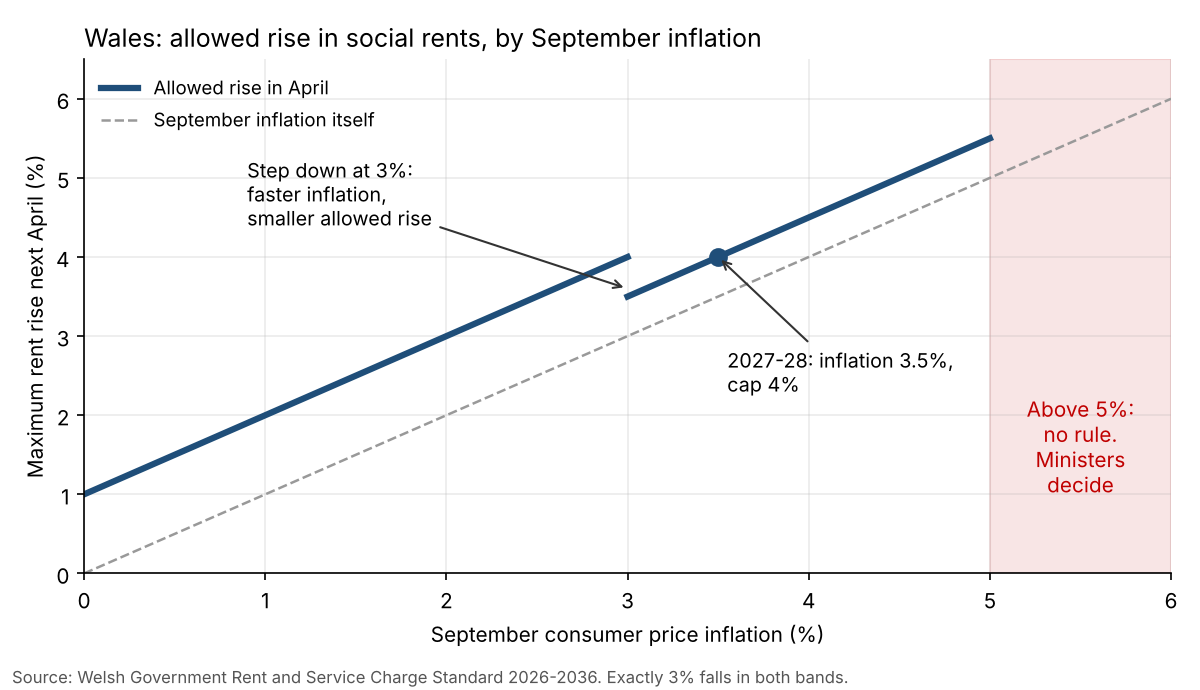
The formula keys off one number: consumer price inflation for September, published by the Office for National Statistics each October. If it falls between 0% and 3%, rents may rise by inflation plus 1%. Between 3% and 5%, by inflation plus 0.5%. Above 5%, the Standard sets no rule, and Welsh Ministers decide the rise for that year. September's figure was 3.5%, so the 2027–28 cap is 4%.
Within that overall figure, a landlord can freeze or cut one tenant's rent and raise another's by up to an extra £2.55 a week, provided its total rent income rises by no more than the cap. Homes that fall empty and are re-let must stay inside the same total. The Standard runs to March 2036, but Ministers may revise or withdraw it at any time, subject to consultation.
The Government's case deserves to be stated fairly, in its own words. Social rent policy, the minister said, must "balance tenant affordability with the financial sustainability of social landlords", and predictable income lets landlords maintain homes and invest. The Standard calls itself long-term certainty for landlords and tenants alike. Social tenants are, by and large, on low incomes. Many cannot easily move. Their landlords are not ordinary sellers, and a household that can't pay the rent ends up somewhere far worse.
Take every word of that as true. What follows is unaffected.
THE AUSTRIAN LENS
The ceiling is the price
The minister stressed that 4% is "the maximum permitted annual increase, it is not an automatic uplift." Last year's record says otherwise. When the cap was 4.3% for April 2026, 10 of the 11 councils that own homes and 23 of 32 housing associations charged exactly 4.3%, according to the Welsh Government's own monitoring report. All but one charged 4% or more.
That isn't greed. Landlords told the Government the Standard already "restricts their ability to meet business plan, investment and landlord obligations." When the most you may charge is less than what you need, the most is what you charge.
So the rent on a social home in Wales is not found anywhere. Not between a landlord who knows what the home costs to heat, fix and insure, and a tenant who knows what it's worth to them. It's set in Cardiff by one percentage, applied to every home from Holyhead to Chepstow. When a home is re-let, the old rent passes to the next tenant whatever the home now costs to keep. Economists have a name for losing the information a price would carry: the calculation problem. Here it's a spreadsheet with one input.
Faster inflation, smaller allowed rise
Read the bands again. If September inflation is 2.9%, rents may rise 3.9%. At 3.1%, they may rise only 3.6%. The faster costs climb, the less room landlords get to cover them, until the formula switches off altogether. Exactly 3% falls into both bands, and the Standard doesn't say which applies.
What next April's rent rise depends on
September inflation | Allowed rise next April | Who decides |
|---|---|---|
2.9% | 3.9% | The formula |
3.1% | 3.6% | The formula |
3.5% (this year) | 4.0% | The formula |
5.0% | 5.5% | The formula |
Above 5% | Not stated | Ministers |
Allowed rise in social rents in Wales against September inflation, 0% to 6%. The line steps down at 3% and stops at 5%, where Ministers decide. Source: Welsh Government Rent and Service Charge Standard 2026–2036.
Above 5%, there is no rule
This is where it gets serious. The Bank of England raised its rate to 4% on 5 November and expects inflation to rise to around 5% by the middle of next year. Next September's figure decides the cap for April 2028. If it lands above 5%, that year's rents are whatever a minister says.
We know what that looks like. The old rules also handed the decision to ministers once inflation left the 0% to 3% range, and ministers had to step in three times in five years. The last two were the big ones. In September 2022 inflation was 10.1%, and the minister set the cap at 6.5%. A year later inflation was 6.7%, and the cap was set at 6.7%. Both times, the cap came in at or below inflation itself.
Had the old rule's normal setting, inflation plus 1%, applied in those two years, rents could have risen 11.1% and then 7.7%. Against that, the two decisions left social rents in Wales about 5% lower, and the gap never closes, because every later rise is applied to the lower base.
A housing association borrows against its rent. Its lender wants to know the income in year two. Below 5% inflation, that's a sum. Above it, it's a guess about a minister's politics in October.
You can price a rule. You cannot price a discretion.
Who pays for the cap
In October 2023, the Welsh Government estimated that about three-quarters of social tenants had all or part of their rent paid by UK benefits. For them, the cap mostly limits what the benefits system pays, not what they pay. The tenant who does feel a capped rent is the one who pays it themselves.
The family in the cold open pays nothing under the cap, because they have no home to pay it on. The Government wants 20,000 more social homes. The money for them comes from rent, borrowed against at a rate that has just gone up. Capping the income doesn't make the homes cheaper to build. It makes fewer of them add up.
REAL-WORLD BUSINESS IMPACT
If you lend to or invest in Welsh housing associations
— Income for 2027–28 is now known. It can rise by at most 4%, and last year almost every landlord took the maximum.
— Income for 2028–29 is not. If September 2027 inflation tops 5%, a minister sets it, and the Bank of England's central path runs close to that line.
— The track record runs one way. In the last two ministerial decisions, the cap came in at or below inflation: 6.5% against 10.1%, then 6.7% against 6.7%.
If you build or supply for social landlords
— Budgets move together. Every landlord's rent income rises by roughly the same percentage, so pressure lands across the sector at once.
— New homes sit outside the total in their first year. Homes let for the first time part-way through a year are outside that year's rent total. Re-lets are not.
— A ministerial cap would squeeze everything at once. A cap set below inflation would cut maintenance and new-build budgets in the same year.
If you're a tenant, or waiting to become one
— The 4% is a maximum, not a promise. Your landlord's board decides, usually between November and January.
— Your rent may differ from your neighbour's. Individual rents can move by up to £2.55 a week more or less than the average.
YOUR ACTIONABLE TAKEAWAY
This is analysis, not legal or financial advice. Check the Standard and your own agreements before acting.
01 · Lenders and investors: model 2028–29 rental income in three cases. If September 2027 inflation is below 3%, the cap is inflation plus 1%. From 3% to 5%, it is inflation plus 0.5% (exactly 3% falls in both bands). Above 5%, it is a ministerial decision; test it against the last two, 6.5% and 6.7%, each at or below inflation that year.
02 · Boards and finance directors: diary the September 2027 inflation figure. The ONS publishes it in October 2027. Above 5%, your 2028–29 rent is not yours to model.
03 · Landlords setting rents: check every expected re-let against your overall 4%. Do it before you commit to its rent. Re-lets count; first-time new-build lets don't.
04 · Contractors and suppliers: ask your social landlord clients which schemes assume rent rises above the cap. Those are the ones at risk if 2028–29 goes to a minister.
05 · Tenants: ask your landlord what it will charge from April and how it decided. Landlords must show the Welsh Government how they consulted tenants.
THE FREE-MARKET ALTERNATIVE
Drop the formula, the ministerial override and the grants that tie landlords to them, and let each landlord and tenant agree the rent, so that what a home costs and what it is worth show up in one number.
That protects the family still waiting, because homes get built where the rent shows they are short, rather than where a capped budget happens to stretch.
And it replaces an order Ministers can rewrite every October with one rule for every landlord and every tenant: a price both sides agreed.
If the goal is 20,000 more homes, ask the Government to show that capping the income that pays for them builds more of them.
OVER TO YOU
If you sit on a housing association board, lend to one, or build for one: what did last April's capped rise make you cut, delay or cancel? Reply and tell me. I read every one.
Stay free,
Jean-Pierre
The Austrian Actor
P.S. New here? Every past issue is in the archive at theaustrianactor.com.
Before you go: if this made a policy clearer, forward it to one person it affects. When they subscribe with your link, you get our Policy Impact Checklist, and five referrals earn you a short private explanation of any policy you choose.
