


The Austrian Actor
WHERE AUSTRIAN ECONOMICS MEETS REAL WORLD ACTION
ISSUE #30
FLAGSHIP EDITION
A litre of South African petrol has twelve price lines, all set by the state. Who pays, why the 'smoothing' levy never pays out, and what a free market would do.
You pull into a forecourt in Gauteng on Wednesday 4 November. You run deliveries in a bakkie, the South African word for a pickup truck, and it runs on petrol. The radio has been saying for a fortnight that the government is cutting the fuel levy by R1.50 a litre.
The pump says R30.24. Last month it said R30.25. One cent.
At the next pump, a haulier is filling a truck with diesel. His levy cut was R3.00, and the official diesel price is down about R1.10. He is not celebrating either. He has to price a contract that runs past 2 December, when the cut halves, and past 6 January, when it ends.
Neither of you was asked about any of it. Most of the numbers on both pumps were set somewhere else.
POLICY SPOTLIGHT
In the Medium-Term Budget Policy Statement on 21 October, the Finance Minister announced temporary fuel relief, citing the war that closed the Strait of Hormuz and the pressure of rising fuel prices on households and businesses. By notice under the Customs and Excise Act, the general fuel levy fell from 410c to 260c a litre on petrol and from 393c to 93c on diesel, from 4 November to 1 December. Two further notices are already gazetted: a smaller cut from 2 December to 5 January (310c and 243c), and the full levy back from 6 January.
The Treasury puts the cost at R10 billion in forgone revenue, funded by returning R10 billion "that was transferred to the Central Energy Fund". On the same day the relief began, the Department of Mineral and Petroleum Resources raised the slate levy from 87.66c to 135.84c a litre, because the slate, the account that tracks what the price formula under-recovered, stood at minus R15.876 billion at the end of September.
This is the second relief round of 2026. The first took R3.00 off both fuels in April, was cut back in June and was gone by July.
Concede what is fair. R10 billion is real money left with motorists and businesses. Diesel got the bigger cut, and diesel moves food, freight and farms. The relief is funded, not borrowed, and its end is announced in advance. And a price that jumped R3.06 a litre in one month, as petrol did in April, is hard on any household budget.
Take every word of that as true. What follows is unaffected.
THE AUSTRIAN LENS
Start with the litre. Here is everything in the R30.24 you paid on 4 November, line by line, from the official price structure.
One litre of 95 petrol in Gauteng, from 4 November 2026
Line | Cents | Set by, paid to |
|---|---|---|
Basic Fuel Price | 1,844.33 | DMPR formula; the supplier |
General fuel levy | 260.00 | Finance Minister; Treasury |
Carbon fuel levy | 19.00 | Finance Minister; Treasury |
Road Accident Fund (RAF) levy | 225.00 | Statute; the RAF |
Slate levy | 135.84 | DMPR; repays importers' shortfall |
Customs and excise | 4.00 | Statute; Treasury |
Petroleum products levy | 0.33 | Statute; the regulator |
Retail margin | 320.00 | DMPR; the forecourt |
Wholesale margin | 66.50 | DMPR; the oil company |
Storage and distribution | 58.10 | DMPR; the industry |
Zone differential (to Gauteng) | 91.10 | DMPR; the industry |
Pump rounding | -0.20 | |
Pump price | 3,024.00 |
Six lines are taxes and levies: R6.44 a litre, about a fifth. The margins and costs fixed by the department come to R5.36. The rest, R18.44, is the Basic Fuel Price. Even that is not a price anyone paid. It is a formula for what an importer would pay to land a litre from an international refinery.
Who actually pays
You do, every line, at the pump. If you are a business, your customers do, in what you charge them. The layers do not decide whether you pay. They decide who the money goes to, and they move by decision, not by bargain.
Diesel shows how deep the layers go. Its levies are the same kind, but a farmer, forester or miner can claim back 262.2c a litre of fuel levy and Road Accident Fund (RAF) levy on eligible litres, under a separate notice. One buyer's levy is another's rebate. Every layer is a decision taken by someone who is neither the buyer nor the seller of the fuel.
Where the R1.50 went
Compare November with October, line by line. The fuel levy fell 150c. The slate levy rose 48.18c. The Basic Fuel Price rose 100.82c. Everything else stayed where the department had set it. Net: one cent.
The relief was real. It was simply cancelled out, by the world price and by a levy the state collects to repay its own account. The headline was the R1.50. What you did not see was the rest of the arithmetic.
It looks like insurance
The slate is the strangest line in the table, and it deserves the most attention. It tracks the gap between what the formula lets importers charge and what fuel actually cost them. When the formula runs behind a rising world price, the gap builds up as a deficit. Once that deficit passes R500 million, a slate levy is added to the price, in steps of 4.38c a litre for every R500 million, until the deficit is back under R500 million.
That sounds like insurance against price swings, and price risk is a real cost of buying fuel. Someone has to carry it. But compare the slate with insurance anyone would choose to buy.
— The premium comes after the claim. Insurance is paid in advance by the people who want cover. The slate bills you this month for a shortfall in earlier months. It is less like insurance than a compulsory loan, taken out on your behalf and repaid by whoever buys fuel next.
— Nobody chose the cover. A haulier who would rather pay the true price each month cannot opt out. A farmer who already fixed his price with a supplier pays the same levy per litre. One risk appetite is imposed on everyone.
— It never pays out. When the formula over-charges, the surplus waits in the account for the next shortfall. Under the notice that set up the slate's funding, a positive balance "will not be utilised". It is never handed back as a lower price. On 4 November the formula was over-recovering R3.32 a litre on petrol, and you still paid R1.36 a litre of slate levy.
— The insured party is not you. The levy is paid out to cover the importers' negative slate. The cover protects the regulated industry, and the state's monthly headline price, from a lag the state's own monthly formula creates.
Who else gained from the months when fuel was sold below cost? Everyone who bought it then, and their customers. That is the point: the bill falls on whoever happens to buy later.
Two fuels, one forecourt
Petrol costs the same at almost every station in South Africa for one reason. The state sets the petrol pump price, adjusted on the first Wednesday of each month, including a fixed retail margin of R3.20 a litre. A forecourt cannot undercut its neighbour, so it competes on everything except price.
Diesel is the control group. The department publishes a diesel wholesale price only as a reference. As the Fuels Industry Association puts it, "diesel retail prices are not regulated". Retailers set their own diesel prices, and they differ from one site to another. When world prices spiked in March, some stations raised diesel before the official adjustment date. An official called that "double dipping". It was also the price telling the truth early.
That is what a free petrol market would look like: prices that vary by place and by seller, discounts and loyalty schemes, prices that follow the world price within days in both directions, and buyers who want stability buying it for themselves.
Free markets in fuel are not always fiercely competitive. In 2023 the United Kingdom's competition regulator found that "competition between retailers has weakened in recent years" and that retail margins "have risen significantly since 2019". But its answer was more information for drivers, not a fixed price. Where margins are fat, the remedy is a new seller down the road. A fixed R3.20 margin is the one price nobody can bargain down.
What the price was trying to say
When the Strait of Hormuz closed, fuel became scarcer. A rising price carries that one fact to millions of people who need know nothing else: drive a little less, combine trips, check the contract, hold more stock, hedge. Friedrich Hayek's 1945 essay, "The Use of Knowledge in Society", made exactly this case: the price system is a way of telling everyone what has changed, without anyone needing to know why.
South Africa's system delays the message, turns part of it into a deficit, then delivers it later as a levy, with a cut announced on top and a return scheduled behind it. The business deciding today decides on the wrong price. Good economics looks past the immediate effect of a policy to its longer effects, and to every group it touches, not just one. The immediate effect here is a one-cent change. The longer effect is a bill that arrives later, in instalments, on whoever buys next.
“Without the slate, prices would swing every month”
That's the best objection. But prices do swing; the slate only moves the swing in time and adds a bill. And markets smooth prices without a state account: through forward contracts, fixed-price fleet cards, stockholding and competing retailers, each chosen and paid for by the buyer who wants it. The smoothing the slate provides is also smoothing of the state's own making. The formula sets one price a month, so it is bound to fall behind a moving market.
The 2026 pump price for 95 petrol in Gauteng, and the fuel levy and slate levy inside it.
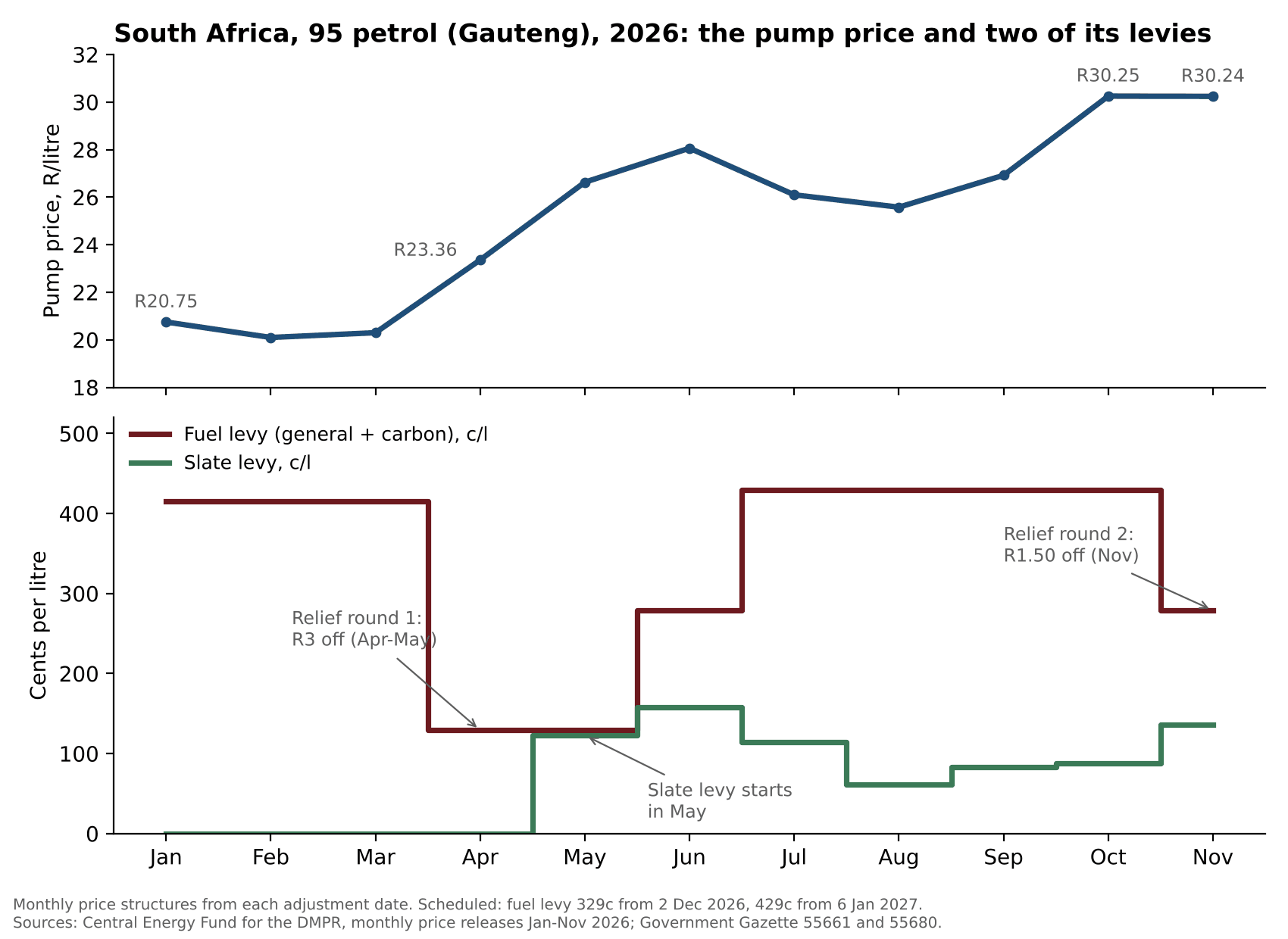
South Africa's fuel levies in 2026
— January to March: fuel levy 415c, slate levy nil. Petrol R20.75 in January.
— 1 April: the base fuel levy rises to 429c and the RAF levy to 225c, and relief round one cuts the fuel levy by R3.00 to 129c. Petrol R23.36.
— 6 May: the slate levy starts, at 122.70c. The slate stood at minus R14.173 billion at the end of March. Petrol R26.63.
— 3 June: relief halved (fuel levy 279c); slate levy 157.74c, after the slate reached minus R18.28 billion at the end of April. Petrol R28.06.
— 1 July: relief "fully phased out" (429c); slate levy 113.94c.
— August to October: slate levy 61.38c, then 83.28c, then 87.66c. Petrol R30.25 in October.
— 4 November: relief round two (279c); slate levy 135.84c. Petrol R30.24.
— 2 December and 6 January: fuel levy 329c, then 429c, already gazetted.
A smoothing that only smooths one way
Each layer on its own has a reason. Together they turn the price of a litre of fuel into a set of decisions taken by ministers, a department and a formula, and paid for by the motorist filling up. The relief is announced. The slate is not. The return of the levy is already in the Gazette.
REAL-WORLD BUSINESS IMPACT
If you run petrol vehicles in South Africa
— Budget for the steps, not the headline. The fuel levy rises 50c on 2 December and another R1.00 on 6 January, whatever happens to world prices. The slate levy can change on any first Wednesday.
If you buy diesel
— Shop around and negotiate. Diesel's retail price is not regulated, so it varies by site and by contract. Check whether your use qualifies for the diesel refund; the rate changes with each notice.
If you price contracts that run into 2027
— Price the levy dates into the contract. A fuel clause that tracks the official price structure, or a fixed-price supply deal, passes or carries the risk explicitly instead of by surprise.
If you hold fuel stock
— Stock bought before a levy rise is worth more after it. The 2 December and 6 January steps are known in advance. So, for diesel, is your supplier's freedom to move early.
Reading your own fuel price
— Step 1. Write down this month's pump or wholesale price for your fuel and zone.
— Step 2. Find the month's price structure in the official release and note the fuel levy, the slate levy and the RAF levy.
— Step 3. Add the levies. That is the part of your price set by the state, whatever oil does.
— Step 4. Note the next gazetted levy date and the next first Wednesday.
— Step 5. Decide how much price risk you want to carry, and buy the rest of your stability yourself: a fixed price, a fuel clause, or stock.
YOUR ACTIONABLE TAKEAWAY
This is analysis, not legal or financial advice. Check your own position with an adviser.
01 · Diary 2 December and 6 January. The fuel levy rises on both dates under notices already published.
02 · Read the price structure each month. The slate levy is the line most likely to move without a headline.
03 · If you buy diesel, get quotes. Its retail price is not regulated, so the spread between sites is yours to use.
04 · Put a fuel clause in contracts that run into 2027. Name the official price structure as the index, so both sides know what moves the price.
05 · Buy your own smoothing if you want it. A fixed-price supply deal or a fleet card costs something, but it is cover you chose.
THE FREE-MARKET ALTERNATIVE
Abolish the fuel levy for every fuel user alike, end the slate, and let the petrol pump price be set by forecourts, as diesel's retail price already is, with site licences open to any seller.
That protects the bakkie driver and the haulier, who would pay the real price of fuel and keep what the levy took, and the new forecourt that wants to undercut a fixed margin.
It restores a price that tells the truth when the world changes, and leaves the choice of how much risk to carry with the people who carry it.
OVER TO YOU
If you buy fuel for a business in South Africa, how do you handle the first Wednesday: a fuel clause, a fixed-price deal, stock, or simply paying it? Reply and tell me.
Stay free,
Jean-Pierre
The Austrian Actor
P.S. New here? Every past issue is in the archive at theaustrianactor.com.
Before you go: if this made a policy clearer, forward it to one person it affects. When they subscribe with your link, you get our Policy Impact Checklist, and five referrals earn you a short private explanation of any policy you choose.
