


The Austrian Actor
WHERE AUSTRIAN ECONOMICS MEETS REAL WORLD ACTION
ISSUE #31
STANDARD EDITION
India taxes fuel exports at a rate it resets every fortnight, on a 'public interest' test alone. What that costs refiners, buyers and India's own supply.
You trade diesel out of a refinery on India's west coast. A buyer in East Africa wants a cargo for January, at a fixed price, and wants your answer by Friday.
You know your cost. You know his offer. You do not know the tax.
India charges a duty on every litre of diesel that leaves the country, and the Finance Ministry changes it about every two weeks. Your cargo will clear after at least three more changes. Each will arrive as a short notice in the official Gazette, in force within a day.
So you do what traders do with a number nobody can tell them. You quote short, you quote high, or you don't quote at all. The buyer, who has other suppliers, notices.
POLICY SPOTLIGHT
On 27 March, in the middle of the West Asia supply crisis, India put a tax on exports of diesel and jet fuel. The Finance Ministry gave its reason plainly: to "ensure domestic availability of petroleum products by disincentivising exports". The same Gazette cut the special excise on fuel sold at home to Rs 3 a litre on petrol and to nil on diesel. Petrol exports were first charged in May.
The duty is a Special Additional Excise Duty, plus, on diesel at times, a Road and Infrastructure Cess. The Ministry says it reviews the rates every fortnight, by the average world prices of crude oil and fuels since the last review. It has set them fifteen times. The rates in force since Saturday 31 October, under Notifications 55/2026 and 56/2026, are nil on petrol, Rs 11.5 a litre on diesel and Rs 11 a litre on jet fuel. The next setting is due around the middle of November, and the one after around 1 December. No law fixes either date.
Two other rules make the duty bite. The usual routes by which exports leave India untaxed, a rebate or export under bond, were closed for these three fuels the same day. And exports by state-owned oil companies to six neighbours are exempt: Nepal, Bhutan, Bangladesh, Sri Lanka and, since 30 June, the Maldives and Mauritius.
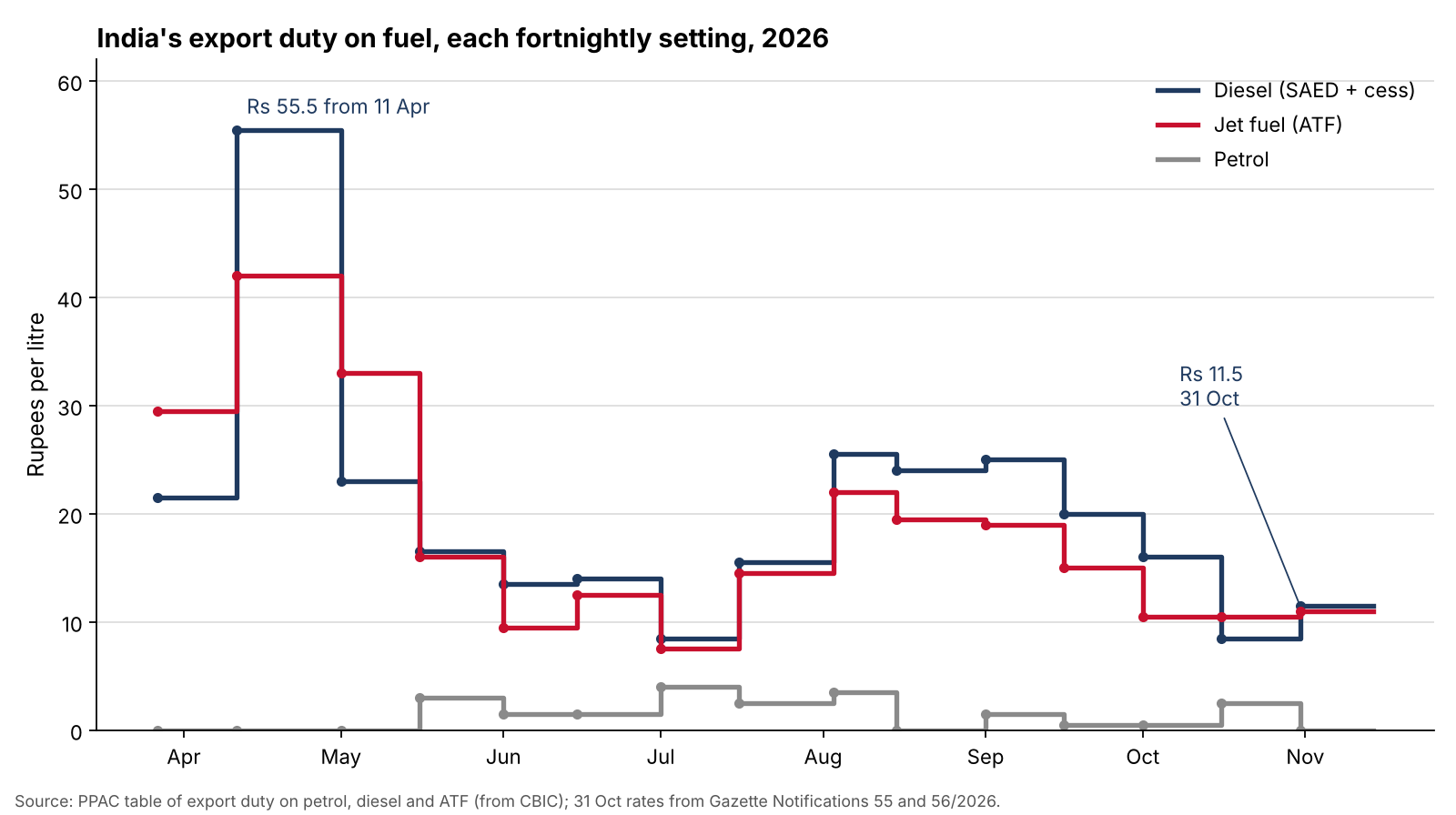
Concede what is fair. The supply shock was real. The Government cut the tax on fuel at home on the day it taxed fuel going abroad. And the export duty has fallen as world prices eased: diesel's was Rs 55.5 a litre in mid-April and is Rs 11.5 now, and petrol's is back to nil.
Take every word of that as true. What follows is unaffected.
THE AUSTRIAN LENS
What the export price was saying
When a buyer in Singapore or Mombasa offers more for Indian diesel than buyers at home will pay, that offer carries something nobody in Delhi knows better: diesel is scarcer there than here, for now. It tells the refiner to ship. It tells the refiner's owners that more capacity would pay. And it tells the buyer abroad that India is a place to get diesel from.
That price is discovered. Two parties who could each walk away agree it. The duty replaces part of it with a number set in a ministry, and the decision to export now turns on that number. The refiner is no longer asking only what the buyer will pay. He is asking what the duty will be on the day the cargo clears, and he cannot know.
A tax set by satisfaction
Read any of the notifications and you find one legal test. The Government acts "being satisfied that it is necessary in the public interest so to do". The press releases add that rates follow average world prices since the last review. That describes a habit. It is not a formula anyone outside the Ministry can run, and nothing in the law obliges the Ministry to follow it.
The result is in the chart below. Diesel exporters have paid anything from Rs 8.5 to Rs 55.5 a litre since March, across fifteen settings. Jet fuel has ranged from Rs 7.5 to Rs 42.
You can price a rule. You cannot price a discretion.
A fixed tax of Rs 20 a litre, however bad, could be written into a contract. A tax that is whatever the Ministry is satisfied it should be, a fortnight at a time, can only be guessed. And whoever claims a share of a sale between two willing parties should have to show why. "Satisfied" is a conclusion, not a reason.
India's export duty on diesel, jet fuel and petrol at each fortnightly setting, 27 March to 31 October 2026, in rupees per litre.
Who gets the fuel, and who pays
The visible winner is the buyer at home, who gets diesel the world would have paid more for. The cost falls on the exporter, who takes less than his buyer offered, and in practice on India's private refiners, because state-owned companies selling to the six neighbours pay nothing. Two firms shipping the same diesel to the same region can face different taxes depending on who owns them.
Some reports call this a windfall tax. A margin a foreign buyer pays willingly is not a windfall. It is the signal that more refining would pay, and the reward for having built the refinery in the first place.
The refinery nobody builds
Good economics looks past the immediate effect of a policy to its longer effects, and past the group it helps to everyone it touches. The immediate effect here is fuel kept at home this fortnight. The longer effect is on capital. A refinery expansion pays back over years. If the reward for building it is taxed away whenever it appears, at a rate reset every two weeks, the expansion waits. The fuel it would have made never appears, at home or abroad.
The policy rests on an old idea: that fuel sold abroad is fuel lost. It is not. Exports are how a country pays for what it buys from others. A farmer who sells grain to the next town has not lost the grain. He has been paid for it, and next year he plants more.
“Without the duty, the pumps would run dry”
That is the best objection. But fuel leaves only when someone abroad will pay more than anyone at home. If buyers at home will pay that price, the fuel stays, without a notice in the Gazette. The honest cost is that in a shortage, prices at home would rise towards the world's. That rise is also what draws new supply in. The duty creates no fuel. It decides by decree whose bids count, and it lowers the reward for producing more, which in a shortage is the opposite of what is needed.
Temporary, since March
None of the notifications carries an end date. The duty was brought in for a crisis, and nothing in the law says when it stops. A measure that ends only when the Ministry is satisfied it should end is not temporary. It is open.
REAL-WORLD BUSINESS IMPACT
If you refine or trade fuel in India
— Your export margin is a fortnightly variable. Any cargo that clears after the next setting carries a tax you cannot know when you sign. Diesel's duty has moved by as much as Rs 34 a litre from one setting to the next.
— There is no rebate route. Export under bond and the export rebate are closed for these fuels, so the duty is a cost, not a timing difference.
— The state-owned exemption is a competitive gap. In the six neighbouring markets, a state-owned seller ships duty-free while you pay.
If you buy Indian diesel or jet fuel abroad
— Your supplier's price now includes a policy variable. Importers, distributors and airlines should expect shorter quotes, wider margins or clauses that pass the duty on to you.
— Supply can be cut by notice. In April the diesel duty more than doubled from one setting to the next.
If you hold shares in Indian refiners
— Export earnings carry a risk nobody can size. Don't invent a number for it. Raise the return you require and let marginal cases fail the higher bar.
YOUR ACTIONABLE TAKEAWAY
This is analysis, not legal or financial advice. Check your own position with an adviser.
01 · Diary the resets. They have come around the 1st and the 16th of each month. Check the Gazette notification itself each time, not a press report of it.
02 · Put a duty clause in every export contract that runs past the next reset. Say who carries any change in the export duty between signing and the day the cargo clears.
03 · If you buy Indian fuel abroad, ask your supplier how the duty is passed on. A fixed price that ignores it is either padded or unlikely to hold.
04 · If you buy in Nepal, Bhutan, Bangladesh, Sri Lanka, the Maldives or Mauritius, check who your supplier is. A state-owned company's cargo to you is exempt; a private refiner's is not.
05 · If you invest in Indian refiners, treat export earnings as discretionary, not contractual. Raise your required return rather than guessing the next rate.
THE FREE-MARKET ALTERNATIVE
Repeal the export duty and cess on fuel and restore the export rebate for every exporter alike, state-owned or private, so a refiner is free to sell to whoever offers most.
That protects the refinery worker and the small trader whose orders now swing with each notice, and the buyer at home who needs the next refinery built.
It restores what a trading nation runs on: a rule that holds long enough to sign a contract against.
If the duty is still being reset long after the shock has passed, its aim was never availability.
OVER TO YOU
If you buy or sell Indian diesel or jet fuel, how are you pricing cargoes across the resets: a duty clause, shorter contracts, or another supplier? Reply and tell me.
Stay free,
Jean-Pierre
The Austrian Actor
P.S. New here? Every past issue is in the archive at theaustrianactor.com.
Before you go: if this made a policy clearer, forward it to one person it affects. When they subscribe with your link, you get our Policy Impact Checklist, and five referrals earn you a short private explanation of any policy you choose.
